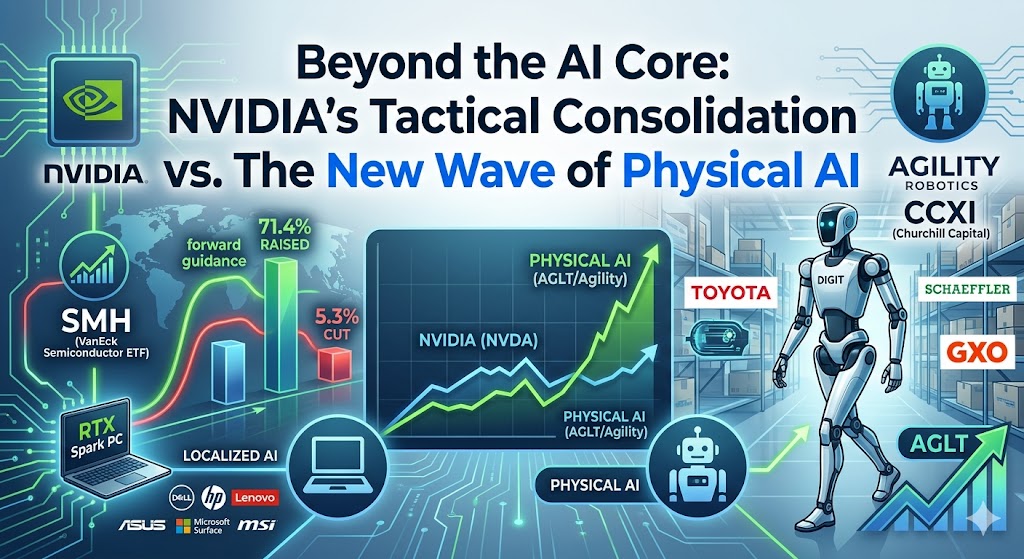
The artificial intelligence investment landscape is undergoing a massive structural shift. While the initial wave of the AI boom focused heavily on centralized cloud infrastructure, smart money is increasingly looking at two emerging frontiers: localized AI edge computing and physical AI (robotics).
Recent blockbuster market developments highlight this exact pivot. On one end, NVIDIA Corporation (NASDAQ: NVDA) is aggressively expanding its geographic footprint and moving into consumer hardware to defend its crown. On the other end, the blockbuster announcement that humanoid robotics pioneer Agility Robotics is going public signals the arrival of “Physical AI” on Wall Street.
NVIDIA’s Dual Defenses: South Korean Alliances & The Laptop Edge
NVIDIA remains a high-conviction staple among institutional hedge funds, but maintaining its multi-trillion-dollar valuation requires securing its supply chain and pioneering new markets. CEO Jensen Huang is tackling both challenges simultaneously.
During a high-profile trip to South Korea, NVIDIA solidified crucial strategic deals with tech titans SK Hynix, Naver, SK Telecom, and the Doosan Group. While the precise financial terms remain undisclosed, the underlying intent is clear: NVIDIA is moving to secure long-term, exclusive access to next-generation memory chips (like High Bandwidth Memory, or HBM) necessary to power its data center AI ambitions.
Simultaneously, NVIDIA is decentralizing AI from the cloud to your desk. Collaborating with Taiwan’s MediaTek, NVIDIA unveiled the RTX Spark PC chip. This represents a three-year joint development effort with Microsoft to “reinvent the PC” for localized, on-device physical AI workloads.
The Semi-Sizing of Momentum: What the SMH ETF Signals
While NVIDIA continues to post strong individual metrics—including a Q1 EPS of $1.87 that beat Wall Street estimates of $1.76—smart investors look to broader industry signals.
The VanEck Semiconductor ETF (SMH) has yielded an astonishing +138% over the past year. However, backward-looking price appreciation matters far less than forward-looking guidance. Inside the SMH portfolio, forward indicators are heavily lopsided toward growth:
- 71.4% of the fund’s total weight represents companies that recently raised forward guidance.
- Just 5.3% of the fund’s weight represents companies that cut their outlook.
- In a literal count, 17 major holdings guided higher, while only 2 guided lower.
NVIDIA (which commands a massive 14.2% weight in the ETF) led the charge by boosting its revenue guidance by 16.7%. Fellow heavyweights like Micron Technology (MU), Intel (INTC), and Advanced Micro Devices (AMD) similarly raised forward forecasts. Conversely, the largest drag came from Qualcomm (QCOM), which trimmed its EPS outlook by 24.0%.
While AMD remains an intriguing contender—climbing 38% year-over-year to log $10.3 billion in quarterly sales—its reliance on lumpy data center revenue (56% of sales compared to NVIDIA’s dominant 92%) leaves NVIDIA firmly in the driver’s seat of chip logistics.
Physical AI Enters the Public Market: The Agility Robotics Merger
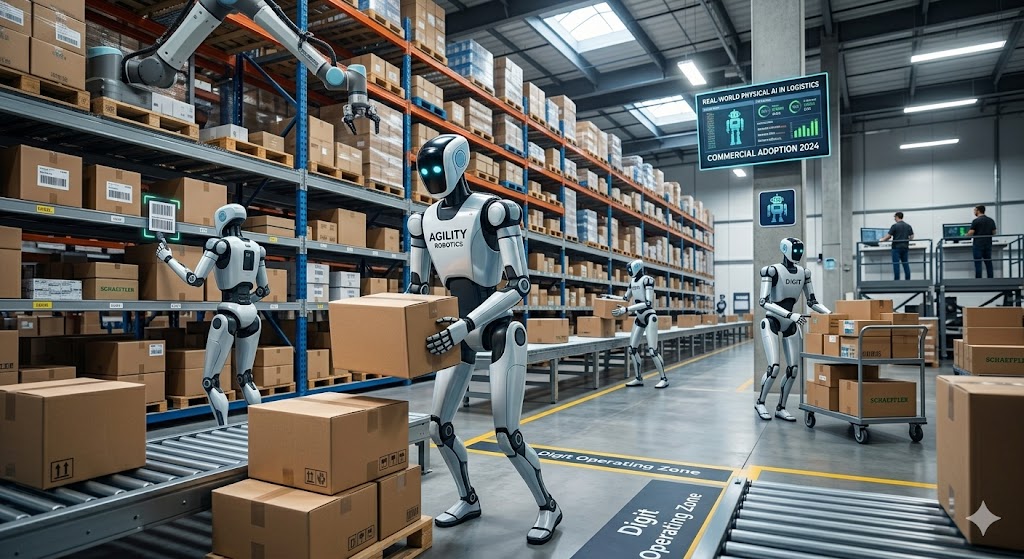
While chipmakers argue over cloud vs. desktop dominance, the ultimate monetization of AI is moving into the physical world. Humanoid robot manufacturer Agility Robotics announced it is going public via a reverse merger with the special-purpose acquisition company (SPAC) Churchill Capital Corp XI (CCXI).
“We believe humanoids are at a meaningful inflection point in commercial adoption… we are focused on meeting growing customer demand, expanding deployments, and advancing our road map across robotics, physical AI, and enterprise software.”— Peggy Johnson, CEO of Agility Robotics
The business combination values Agility at $2.5 billion pre-money. The deal is expected to inject $620 million in cash onto the balance sheet, including a $200 million private placement (PIPE) priced at $10 a share from both institutional and strategic backers.
NVDA Technical Analysis: Navigating the Consolidation Band
Despite robust fundamentals, product expansion (such as the new BioNeMo Agent Toolkit and the Vera Rubin AI platform), and an underground black market in China where banned chips are fetching double their retail price, NVDA stock is feeling short-term macro headwinds.
NVIDIA remains a monumental engine for generative AI. Its long-term fundamentals are buttressed by Jensen Huang’s historic ability to stay ahead of structural shifts—such as hand-delivering the world’s first AI supercomputer to OpenAI back in 2016.
However, at current valuations, NVDA presents a mature risk-reward profile. For investors seeking asymmetric upside, the semiconductor industry’s broad-based confidence signals that adjacent hardware plays, desktop AI hardware updates, and newly public pure-play physical AI companies like Agility Robotics (AGLT) may offer higher raw growth potential in the next chapter of the AI cycle.