When a movie titles itself Chinna Chinna Aasai (Life’s Tiny Wishes) and casts Madhoo in the lead, it’s easy to brace yourself for a wave of pure, nostalgic gimmickry. It immediately invokes that iconic 1992 Roja track that made her a household name.
But within fifteen minutes of Varsha Vasudevan’s brilliantly measured directorial, any fear of cheap nostalgia completely evaporates. What unfolds instead is an extraordinary, near real-time reflection on freedom, late-stage companionship, and the unspoken desires we bury under the weight of societal expectations.
Chinna Chinna Aasai Movie Plot
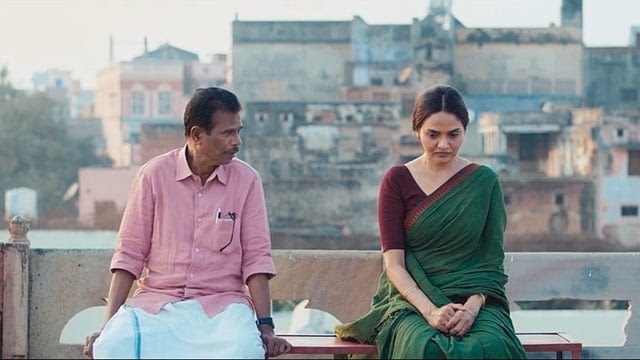
The premise of Chinna Chinna Aasai is beautifully minimalist. Leela (Madhoo), a 52-year-old widow from Thanjavur, finds herself completely stranded in the ancient city of Banaras (Varanasi) after her handbag is stolen, separating her from her tour group.
Enter Madhavan (played with incredible nuance by Indrans), a local Good Samaritan who steps in to help her navigate the maze-like streets. What starts as a simple mission to reunite a lost tourist with her group quickly morphs into a day-long journey of self-discovery. Madhavan becomes Leela’s “guide” for the day, and as they wander through the timeless ghats, important landmarks, and crowded alleyways, their conversations transition from polite small talk to deeply personal confessions about childhood obsessions, complex past marriages, and the looming philosophy of mortality that Banaras naturally breathes into everyone.
The Power of ‘Tiny Wishes’
The true genius of the film lies in how it captures the micro-moments of human behavior. Varsha Vasudevan doesn’t rely on high melodrama; she lets the subtext do the heavy lifting.
Take, for instance, a scene in a local eatery. Leela politely declines Madhavan’s offer to buy her the city’s best mutton biriyani. Yet, the moment he steps out of frame for a brief second, she quietly pulls the bowl toward her and devours a piece of meat. Whether Leela has been a strict vegetarian all her life or was simply bound by the rigid codes of widowhood in Thanjavur is never explicitly spoken—but Madhoo’s body language says it all. It is the visual of a woman finally savoring a desire she has suppressed for decades
Similarly, the film beautifully captures the boundaries of their fast-evolving friendship:
- The Saree Shop Scene: While shopping for a Banarasi saree, Madhavan takes the liberty of placing jasmine flowers in Leela’s hair. The sudden vulnerability creates an instant, palpable awkwardness.
- The Power Dynamic: Instead of letting the distance fester, Leela directly demands an apology. The moment Madhavan complies, her smile flips back on like a switch. It’s a refreshing depiction of emotional maturity rarely seen in mainstream cinema.
Chinna Chinna Aasai Review Verdict
If this exact script were mapped onto a Gen-Z couple, a scene inside a character’s apartment might feel entirely generic or predictable. But watching two veteran actors bring an effortless, platonic comfort to the screen feels incredibly revolutionary.
Driven by spectacular cinematography that utilizes the timelessness of Banaras to mirror the depth of its characters, Chinna Chinna Aasai stands out as a triumph. Indrans and Madhoo deliver career-best performances, reminding us that when the noise of the world fades away, it is always the smallest of things that matter the most.
Our Rating: ⭐⭐⭐⭐½ (4.5/5)